Climate Change & Carbon Credits: A Technical Perspective from Field Practice
Over the past decade, climate change has shifted from being an academic discussion to a quantifiable operational risk that influences project viability, regulatory approvals, and long-term sector planning. In practical terms, we now evaluate climate variables the same way we evaluate engineering constraints — measurable, modelled, and directly linked to investment decisions.
Carbon credits have become a critical instrument within this technical landscape. At their core, carbon credits represent verified reductions or removals of one metric tonne of CO₂-equivalent, established through standardized baselines, monitoring protocols, and third-party validation. For practitioners, the value lies not in the credit itself, but in the data integrity behind the emission reduction — the baseline scenario modelling, leakage assessments, permanence calculations, and MRV (Monitoring, Reporting, Verification) compliance.
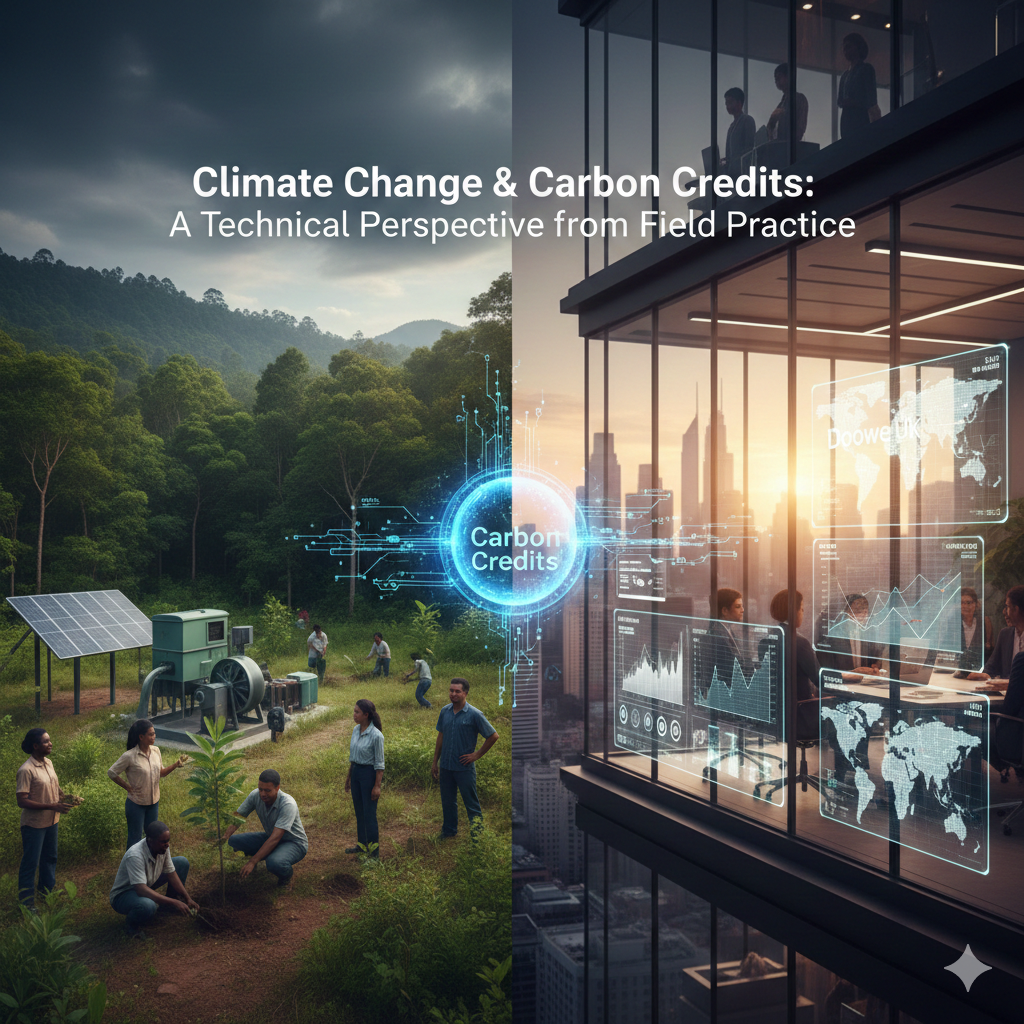
In developing countries, the practical application of carbon credit mechanisms is even more significant. Many projects that we evaluate — whether energy projects, waste systems, or water infrastructure — now incorporate carbon accounting as part of the design logic. This shifts carbon from a “co-benefit” to a “design determinant.” Properly structured, a carbon credit mechanism can mobilize finance for interventions that otherwise remain unviable, especially in rural energy access, efficient water systems, and community-scale technologies.
From a technical standpoint, what gives carbon markets credibility is methodological rigor:
When these elements are present, carbon credits transition from a policy tool to a high-integrity climate instrument capable of delivering quantifiable mitigation outcomes.
As the global climate agenda accelerates, carbon markets are moving toward higher accountability, stronger verification protocols, and closer integration with national climate strategies. For practitioners working directly with regulators, industries, and development partners, the emphasis has already shifted: not on selling credits, but on ensuring that every tonne claimed represents a real, measurable, and durable climate benefit.
This is where the future of climate action will be defined — at the intersection of technical integrity, data-driven climate mitigation, and practical implementation on the ground.
Doowe has two innovative products across our UK and European operations — Doowe Carbon Accounting *and *Doowe Carbon API. The Carbon Accounting platform helps businesses measure, manage, and report their carbon emissions accurately, while the Carbon API allows seamless integration of carbon data and ESG metrics into digital systems for real-time sustainability tracking.
We’re open to collaborations with organizations or individuals interested in carbon management, sustainability, or ESG consultancy. For enquiries or partnerships, more details can be found at www.doowe.uk
Ready to confidently step into the future of sustainable business? doowe is your reliable partner in this journey, providing expert carbon footprint services to ensure your commitment to the environment is clear, concrete, and verifiable.